
The Devil Wears Prada 2 and the Heartbreak of Being a Journalist Right Now
The franchise has come to represent two different things — the industry I thought I was going to get, and the one I actually got.

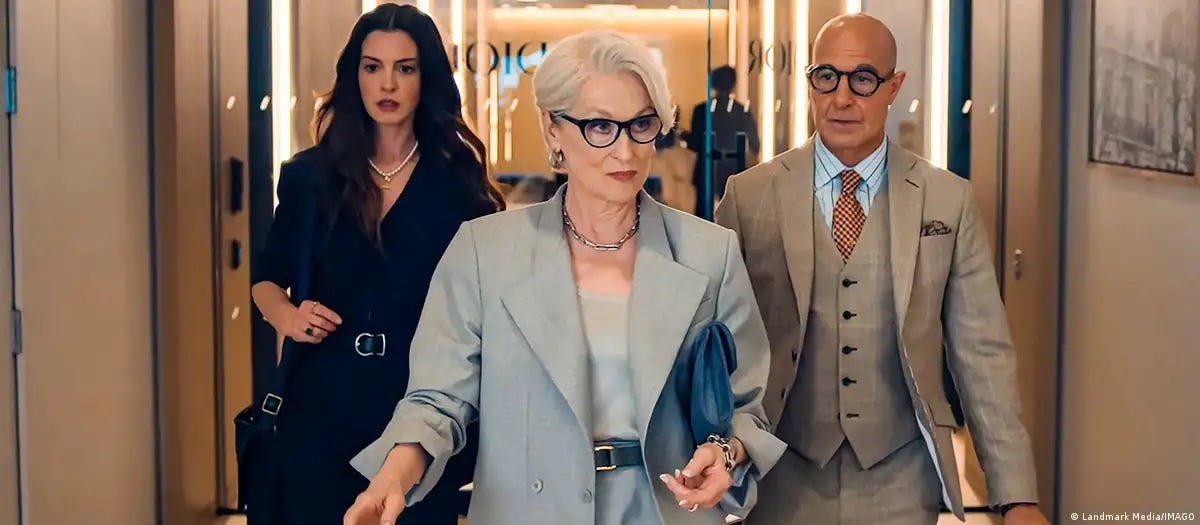
I wasn’t prepared for The Devil Wears Prada 2 to have me so deep in my feelings. The idea that a movie centered around a magazine would actually try to meet the moment and reflect the heavy adversity facing journalism should’ve occurred to me, but it didn’t. So when I found myself sitting in a dark theater, watching the grief I’ve been grappling with reflected to me in IMAX, the silent tears that fell caught me off guard.
As a millennial who grew up dreaming of climbing the editorial ladder at a magazine, this franchise has come to represent two very different things — the industry I thought I was going to get, and the one I actually got.
I was sixteen when the first film came out, and saw a lot of myself in Andy Sachs (Anne Hathaway). I didn’t look down on fashion the way she did initially, but we shared the same hunger to write stories that were more about the people than what they were wearing. To see the glossy world of magazines come to life on screen, and an Editor-in-Chief (my former dream job) like Miranda Priestly (Meryl Streep) exist in such complete, brazen command of her domain, was electrifying. And while I hoped I’d find myself under the tutelage of editors with somewhat more realistic expectations and a bit more empathy, the idea of learning from women so utterly in their power? That thrilled me.
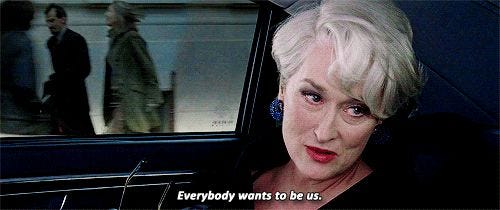
When Miranda looked at Andy in the first film and declared, “Everybody wants this. Everybody wants to be us.” I was everybody. I was one of the millions of girls who would have killed for that job. And seven years later, I got it. At the magazine that was my Vogue.
Now, twenty years later, I find myself seen by Andy’s character for a much sadder reason.
***Spoilers Ahead***
In the sequel, Andy is grappling with the same sadness, anxiety, and quiet fury that I’m navigating in real time over the bewildering fall of an industry we love so much and worked so hard to get into. There are so many moments that hit too close to home. When she and her entire team are laid off despite creating award-winning work. When she writes a story that saves Runway’s reputation, and is raved about by critics, but receives zero applause for it at work because all the higher-ups care about is how many clicks it generated. When she goes above and beyond to land a major celebrity profile, only for Miranda to be the one to get to be the face of it for the on-camera interview. Every time she crashes out about how unfair and heartbreaking it is to watch a rich tech bros take over and dismantle a beloved publication in favor of netting the most profit.
These obstacles spoke to a very specific pain that I didn’t know I needed to see reflected back at me. And something about it being these characters — the same ones I first watched exist before all of this adversity changed media, before it changed me — made the experience even more emotional. Like, the world has shifted so dramatically that even my favorite fictional editors are suffering. Even Miranda MF Priestly is struggling to keep her job!
The movie’s ending offers something close to a happy ending: the jobs are saved, the magazine survives the hostile takeover, Miranda retains creative control of Runway, and Andy (I think?) gets that promotion they spoke about. (Here’s hoping she negotiated a better title and salary for herself.) But those of us who work in this industry know what it actually means to be owned by the lesser of two evils. We’ve lived through the version where even the billionaires with the “best intentions” get more involved than they said they would, more involved than they perhaps even intended. Because shareholders and board members and advertisers and AI and capitalism as a whole will always choose the bottom line over the moral compass. You don’t become a billionaire, and you definitely don’t stay one, any other way.
Still, in this fictional tale, we get to see the film close with our faves doing the job they love most. And I’m still not entirely sure whether it was the fact that so many of us have not gotten that happy ending, or simply how much I love to see women who care this deeply about their craft overcome — but watching them end the movie in their offices (shot at the old Time Life building where I had my first editorial assistant job) producing the next issue made my heart ache.
The hard truth is that most of us don’t have a Nigel who can make one phone call to a CEO and pull us back from the edge of the unemployment abyss as he did for Andy. (Though that reveal, and the “Forever my girl” line made me weep!) Our mentors want to save us. But many of them can’t. There aren’t enough jobs. Even for them. And the ones that exist don’t pay what they should. Certainly not enough to live in the kind of condo Andy somehow bought for herself in this movie.
But here’s the other thing: I didn’t leave the theater feeling despair. Not entirely.
There’s a conversation in the back of Miranda’s town car that I keep turning over in my mind. She talks, unapologetically, to Andy about how much she loves to work. About how her career has been worth every sacrifice, every hardship, every blood-soaked compromise. And that scene reached a part of me I’ve been desperate to call back to the surface. That innate, sometimes delusional drive to build something meaningful even in the wreckage.
Things are hard. Perhaps harder than they’ve ever been in my lifetime. But not the hardest they’ve ever been in history. Listening to Miranda’s speech made me think of all the women who have come before us who figured out how to succeed against their set of impossible odds and lived to be grateful they didn’t quit. I want to be one of them. I’m going to be one of them.
None of this is to say that The Devil Wears Prada 2 is a perfect film. I’ve read warranted critiques that I agree with, particularly around the reduction of characters of color — and the lack of attractive love interests, but I digress!! I’m not here to litigate plot holes or character development failures; I’ll leave that to the film critics. But I felt compelled to share how watching it made me feel less alone, affirmed even, about the systems failing journalists specifically. And how watching Miranda and Andy choose to fight back, despite how thinly said “fight” was filmed, quietly lit something inside me that I didn’t expect. It’s still a small flame. But it’s there. And for that, I’m thankful.
“Even the mentors can’t help - there aren’t enough job” is gutting me.
Once again you always pull me in with your riveting penmanship! I must go see the movie now!🥰👌🏾💜